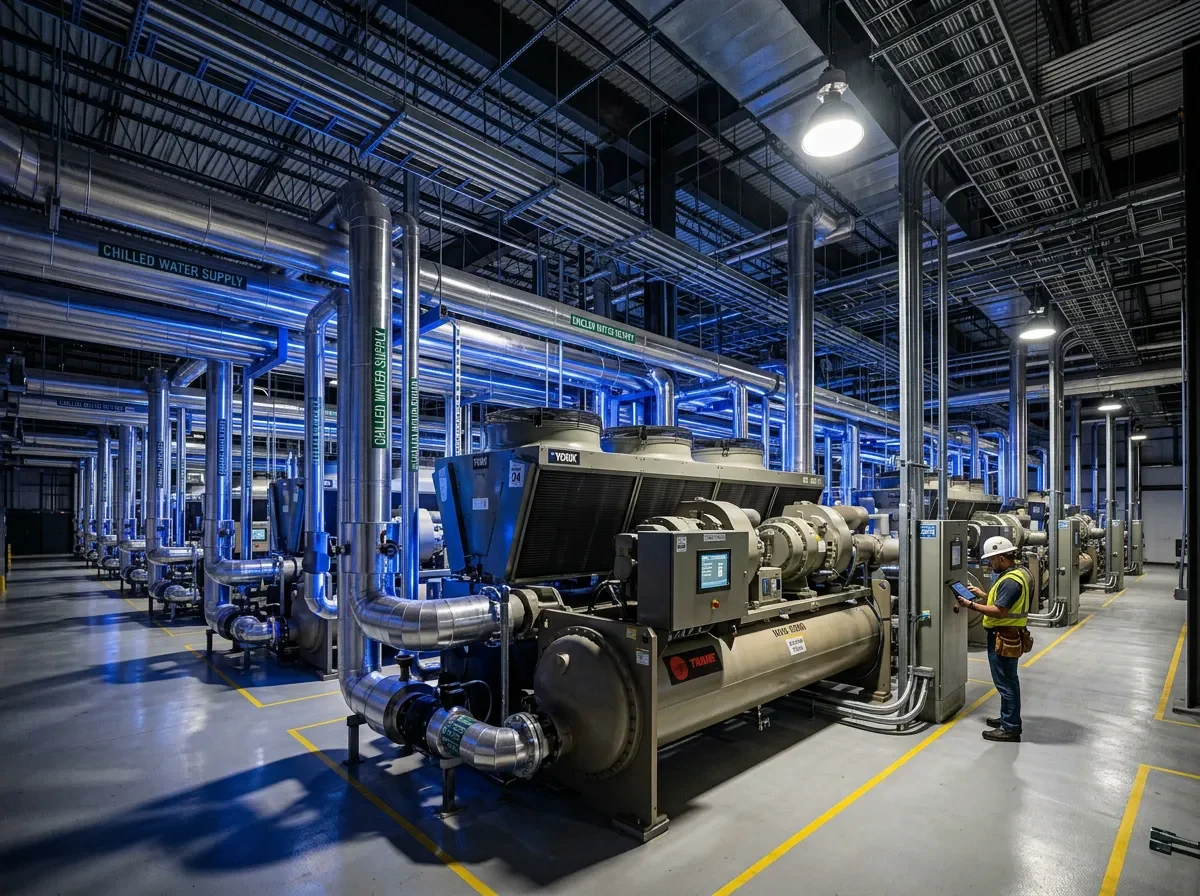
Trane Technologies (TT): the chiller company that became the thermal backbone of the AI buildout
Trane Technologies passes both hard filters: ROE above 29% for four consecutive fiscal years and a 3-year FCF CAGR of ~33% ($1.22B → $2.9B, FY2022–FY2025). With a record $10.7 billion backlog, two data center cooling acquisitions closed in early 2026, and Americas Commercial HVAC bookings up 40% in Q1, TT has repositioned from legacy HVAC maker to full-stack thermal infrastructure provider for AI data centers.

Trane Technologies passes both hard filters: ROE above 29% in each of the past four fiscal years and a 3-year FCF CAGR of ~33% ($1.22B → $2.9B, FY2022–FY2025). What the filters do not capture is why a 100-year-old HVAC manufacturer is sitting on a record $10.7 billion backlog and trading at $470 — up 46% from its 52-week low — while the rest of the industrial sector is flat.
The short answer: every AI data center needs roughly as much cooling as it needs power, and Trane is one of the two companies in the world with the full-stack thermal management portfolio to service that demand at hyperscale.
The hard filters
| Metric | FY2022 | FY2023 | FY2024 | FY2025 |
|---|---|---|---|---|
| ROE | 29.0% | 31.5% | 36.1% | 37.0% |
| Free cash flow | $1.22B | $2.10B | $2.78B | $2.90B |
FCF margins have expanded from 6.2% in FY2022 to 13.6% in FY2025, driven by a deliberate shift away from lower-margin residential equipment toward higher-margin commercial applied systems — the large chiller plants, cooling towers, and building management systems that go into hospitals, universities, data centers, and office complexes. 2
What Trane actually does and why margins keep rising
Trane operates two segments. Americas (roughly 65% of revenue) sells and services climate systems across the US, Canada, and Latin America. International covers Europe, the Middle East, Africa, and Asia Pacific.
Within those geographies, the product mix splits into three categories that behave very differently economically.
Residential (unitary HVAC for homes) is high-volume, low-margin, and cyclical. It has been a headwind through 2025 and into early 2026 as high mortgage rates suppressed home sales and discretionary renovation spending. Management guided the segment flat to down 5% for FY2026.
Commercial applied systems (large chillers, cooling towers, air handlers) are the margin engine. These are custom-engineered systems sold through Trane's direct sales force — no distributor in the middle — and they command pricing power because of long lead times, engineering complexity, and multi-year service contracts that attach to every installation. Applied bookings grew over 120% year-over-year in Q4 2025 and over 40% in Q1 2026, driven by data center demand. 3
Services (maintenance, retrofits, controls upgrades) now compound at a low-teens CAGR, carried by a growing installed base. Every new chiller plant that ships today enters a service revenue stream that runs 8–10x the equipment lifetime value. The service relationship is sticky: switching costs are high, because retrofitting a competitor's controls onto an installed Trane system is expensive and disruptive.
Operating margins have expanded steadily from 14.3% in FY2021 to 18.2% in FY2025. SG&A rose in 2025 because Trane opened a new service technician training facility in Davidson, North Carolina, and is expanding its European channel ahead of backlog conversion — front-loaded costs against expected margin normalization in FY2026.
The data center thesis and what the backlog says

Trane has roughly 10% of total revenue tied to data centers, and that share is growing. 4
In early 2026, the company closed two acquisitions that together complete its data center portfolio. The first was Stellar Energy Americas, a modular turnkey cooling provider that pre-assembles chiller plants in factories rather than on-site, cutting deployment time and reducing on-site labor complexity. The second was LiquidStack, a global leader in direct-to-chip and full immersion liquid cooling — the technologies required to manage next-generation GPU racks that air cooling cannot reach. 5
Together, these two moves gave Trane an end-to-end portfolio: from conventional air-cooled chillers to modular pre-assembled plants to chip-level liquid cooling. No single HVAC competitor has that full stack today.
| Metric | Q1 2026 | vs. Q1 2025 |
|---|---|---|
| Revenue | $4.97B | +6% |
| Adjusted EPS | $2.63 | Beat consensus ($2.53) |
| Backlog | $10.7B | +30%+ YoY |
| Organic bookings | +24% | — |
| Americas Commercial HVAC bookings | +~40% | — |
The backlog converts on a roughly 9-month average order-to-ship cycle. Management guided Americas Commercial HVAC revenue growth of 7–8% for Q1 2026, then said low-teens for H2 2026 as the record Q4 2025 applied bookings flow through. After Q1 beat consensus, full-year 2026 adjusted EPS guidance was raised to $14.75–$14.95 (up 13–15%).
Valuation
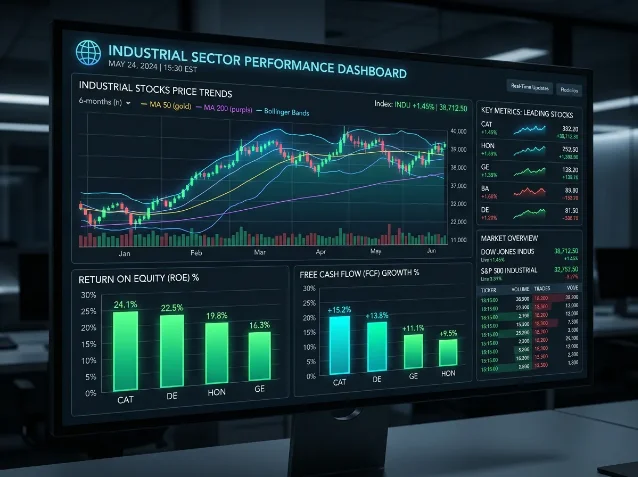
At $470.76 (June 9, 2026), TT trades at: 2
| Multiple | Current |
|---|---|
| TTM PE | 35.9x |
| Forward PE (FY2026E) | ~30.7x |
| P/FCF | 33.2x |
| EV/EBITDA | 25.4x |
| Market cap | ~$104B |
Consensus analyst mean price target sits around $506–507, implying roughly 7–8% upside from current levels. The Street is not projecting a re-rating; it is pricing in backlog execution and nothing more. 7
The historical trading range for TT has been 27–29x forward earnings. At 30.7x today, the stock prices in some premium for the data center option value. The question is whether that option is worth the premium — or whether the premium already captures it.
FCF yield is 3.0%, roughly in line with the 10-year treasury at current rates. That makes TT a neutral-to-slightly-expensive hold on yield alone, not a screaming buy. The investment case rests on whether the backlog-driven growth compounding justifies the multiple, not on a simple reversion argument.
Competitive moat
Trane's durable advantages come from three sources.
Direct channel ownership: The company sells applied systems through its own sales engineers, not independent distributors. This means it captures pricing power and controls the customer relationship from quote to installation to multi-decade service contract.
Service lock-in: Once a building's HVAC infrastructure is Trane, switching to a competitor's controls or service program requires significant re-engineering expense. The service business grows automatically as the installed base grows, with no incremental sales cost.
Full-stack thermal management: Post-LiquidStack, Trane covers every cooling modality — air-cooled chillers, water-cooled chillers, modular pre-assembled plants, direct-to-chip liquid cooling, and immersion liquid cooling. Hyperscalers consolidating their thermal management sourcing have a reason to go to one vendor rather than managing four.
The moat is not IP-protected (competitors like Carrier Global and Johnson Controls play in the same market), but it is scale- and relationship-protected. Trane's direct sales force and installed base are multi-decade assets that a new entrant cannot replicate quickly.
Key risks
1. Chip efficiency improvements compressing service economics. The theoretical risk — raised explicitly by CEO Jensen Huang's commentary that next-generation chips may reduce data center cooling run times — is that GPU power efficiency reduces cooling demand per rack. If cooling intensity per megawatt declines fast enough, the 8–10x service revenue multiple on each installed chiller shrinks. This is real but slow-moving; the current upgrade wave is generating more heat, not less, as dense GPU clusters replace CPU servers.
2. Two consecutive quarters of 100%+ applied bookings are an impossible comp. Q3 and Q4 2025 saw applied bookings growth exceed 100% year-over-year. Q1 2026 stepped down to 40% — still strong, but the trajectory invites a sharp narrative shift if Q2 2026 bookings show further normalization. The $10.7B backlog provides 9–12 months of revenue visibility, but 2027 revenue is not yet in backlog and depends on verticals (healthcare, life science, K-12) that have been slow to recover.
3. Residential drag and tariff costs. The residential segment remains weak through 2026, and the company absorbs an estimated $200 million in annual tariff costs even after mitigation efforts. Both headwinds limit upside to overall margin expansion in the near term. 5
4. Valuation leaves no margin for error. At 30.7x forward earnings, any guidance reduction or backlog slip reprices the stock toward its historical 27–29x range, which implies 5–10% downside from current levels before the multiple catches up to the compounding. The company has executed well, but the stock prices in continued execution.
5. LiquidStack integration risk. Liquid cooling is a newer market with different channel economics than traditional HVAC — hyperscalers buy direct, pricing is less predictable, and the technology standard (direct-to-chip vs. immersion) is still settling. Trane's ability to sell LiquidStack into its existing data center relationships is the key variable; if integration takes longer than expected, the acquisition does not contribute to the 2026–2027 revenue line as modeled.
Trane Technologies is an industrial company that has quietly become the thermal management infrastructure play of the AI buildout. The hard filters cleared, the backlog is real, and the full-stack thermal portfolio is genuinely differentiated. The trade-off for entering today is a premium multiple against a business that needs to keep executing at a level it has not historically sustained.
135参考ソース
- 1Trane Technologies FY2025 Full-Year Results
- 2Trane Technologies TT Financial Ratios — StockAnalysis
- 3Trane Technologies Q1 2026 Earnings Recap — Tickeron
- 4Is Nvidia disrupting HVAC? Trane Technologies and data center cooling — Investing.com
- 5Trane Technologies Stock is Up 17% in 2026, Can It Continue Climbing — TIKR
- 6Trane Technologies Q1 2026 Earnings Conference Call Transcript — SEC/Q4CDN
- 7Trane Technologies Stock Forecast — MarketBeat
このコンテンツについて、さらに観点や背景を補足しましょう。